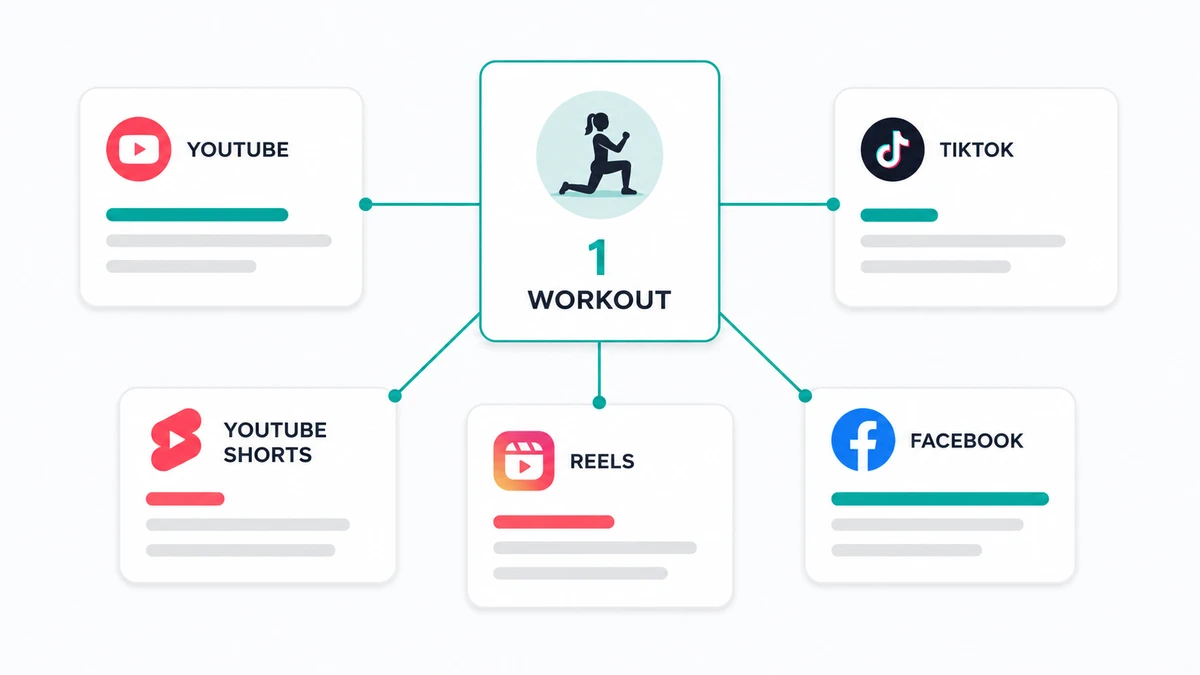
You filmed the workout, cut it into clips, and posted to five platforms with the same caption. Then four of them buried it. It's not your footage — it's the fact that you spoke one platform's language to five different algorithms.
Here's the thing most fitness creators still miss in 2026: every platform is now a search engine, and none of them search the same way. A title that ranks a 20-minute HIIT video on YouTube is the wrong shape for a TikTok caption. The hashtag strategy that helps on Reels does nothing on Shorts. Discovery has quietly become the most important part of posting — 74% of Gen Z now use TikTok as a search engine — so the words around your video matter as much as the video itself.
This is the per-platform playbook: six rules that hold everywhere, then the specific title, caption, and hashtag rules for YouTube, TikTok, Instagram Reels, and Facebook. Steal it, keep it next to your editing setup, and stop letting good workouts get buried.
The 6 rules that hold on every platform
Before the platform-specific stuff, these six apply everywhere. If you only remember this section, you're already ahead of most creators.
- Lead with the keyword, not the hype. Put the exact phrase someone would search —
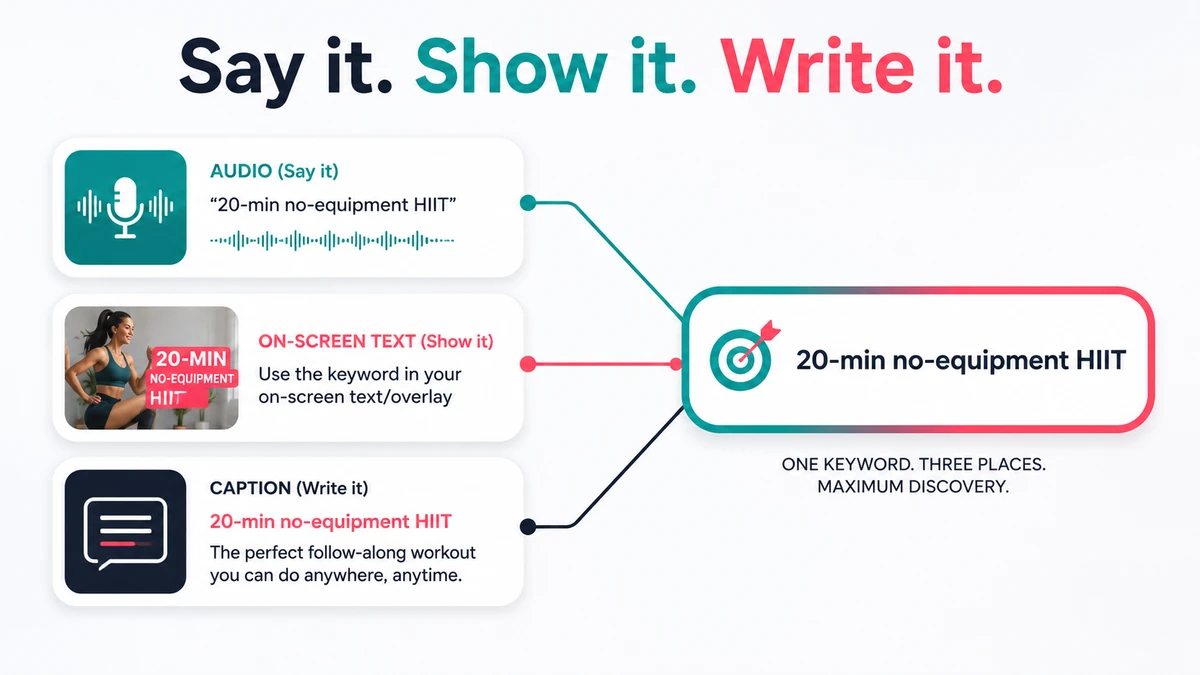
20 minute HIIT no equipment,beginner glute workout at home— at the front of your title or first caption line. "INSANE 🔥🔥" leads with nothing. - Say it, show it, write it — the same phrase. Speak your primary keyword in the first few seconds, put it in your on-screen text, and repeat it in the first line of the caption. When those three line up, discoverability can jump by up to ~50%.
- Front-load the hook. The first line is the only line guaranteed to be seen. Open with who it's for + what it is + the payoff: "Beginner 10-min HIIT, no equipment."
- Use 3–5 precise hashtags, not 30. The era of hashtag walls is over. A few
search-intent tags (
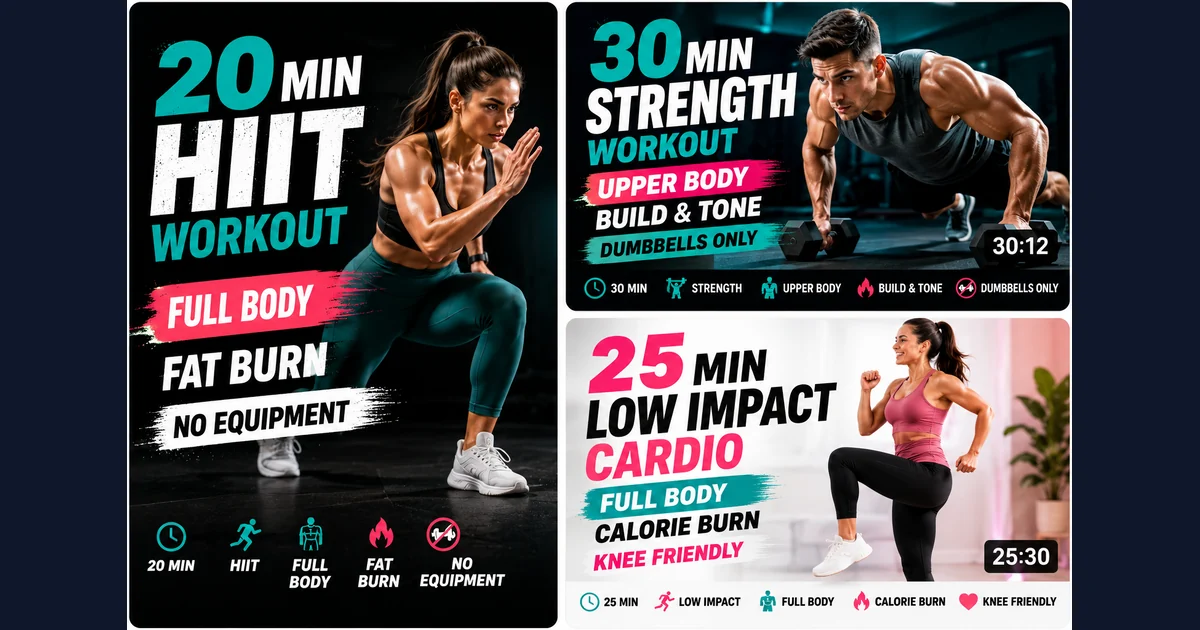
#hiitworkout,#noequipmentworkout) beat a pile of broad ones — and never lean on#fyp. - Name your constraints. "No equipment," "all standing," "low impact," "apartment-friendly," "knee-friendly" — these are the highest-converting words in fitness titles because they answer "can I do this?" instantly.
- One clear CTA. Pick a single action per post — usually "save this" or "send it to a friend," which the algorithms weigh more heavily than likes. Don't ask for five things at once.
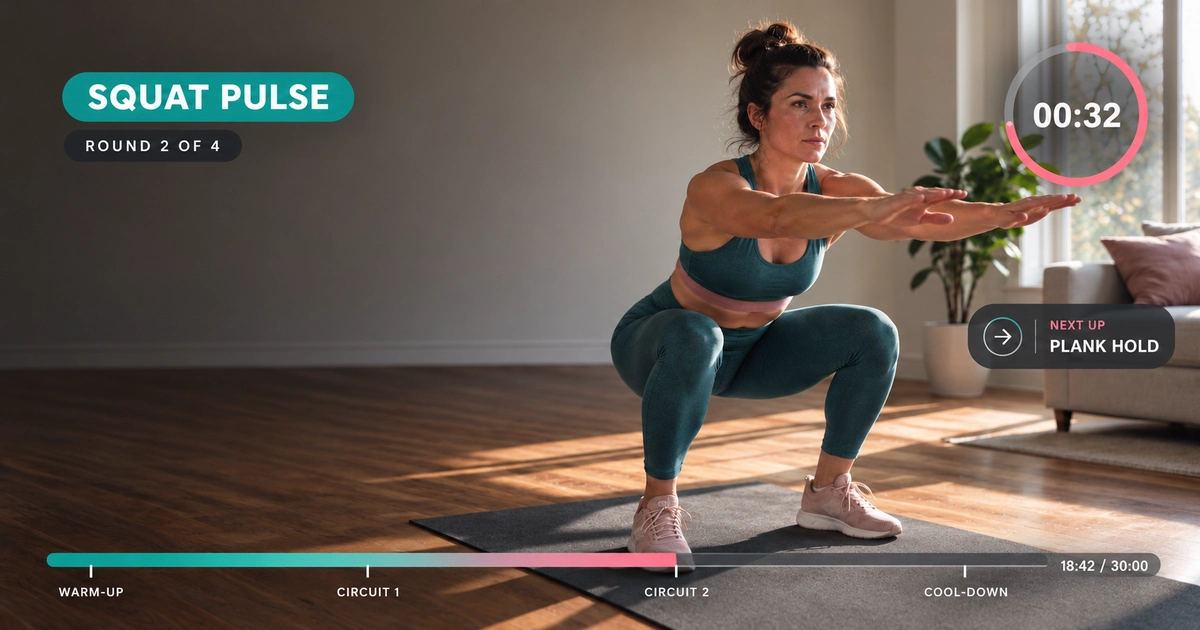
Rule 2 is the one creators sleep on, so it's worth seeing. Pick one primary keyword and make it show up in all three places the algorithm is "listening":
Now the per-platform specifics.
YouTube (long-form)
Long-form YouTube is the most search-driven surface you post to. Titles and the first lines of your description do real ranking work.
Title — aim for 50–60 characters, with your primary keyword in the first ~40. A formula that consistently works for workouts:
{Duration} Min {Type} Workout – {Body area} {Outcome} ({Constraint})e.g. "20 Min HIIT Workout – Full Body Fat Burn (No Equipment)"
Use one hype word at most ("Killer," "Intense") — hype plus structure beats hype alone.
Description — order matters:
- Hook line (≤120 characters) with the exact keyword and one benefit. The first 100–150 characters are what show in search, so make them count.
- 1–2 short paragraphs expanding the promise (rounds, intervals, equipment, mods).
- Chapters — these only render if the first timestamp is
0:00and you have at least 3 chapters spaced ≥10 seconds apart (Warm-Up, Circuit 1, Circuit 2, Cool-Down). Chapters are free retention and SEO; use them on anything 8+ minutes. - CTA + links, then 3–5 hashtags at the very bottom (YouTube ignores all of them if you use more than 15).
YouTube Shorts
Shorts are not mini long-form videos — the metadata rules are different.
- Title: 4–6 words, ≤40 visible characters, keyword first. "5 Standing HIIT Moves – No Equipment."
- No hashtags in the title — they belong in the description.
- Description: 150–500 characters. Sentence one = keyword + what/why. Then one
benefit or the move list, a simple CTA ("Full 20-min version on my channel →"), and
3–5 hashtags including
#Shortsplus one or two category tags.
TikTok
TikTok's interest-graph shows your video to strangers first, which makes it your best cold-discovery engine. Caption for curiosity and search.
- Hook (first 3 seconds): audience + format + benefit, spoken and/or on-screen. "This 8-minute HIIT can replace your jog."
- Caption — pick a mode:
- Engagement: one punchy line, 50–150 characters.
- Search: a longer caption weaving in 2–3 long-tail keywords in full sentences ("beginner HIIT at home," "no-jumping fat-burn HIIT"). TikTok allows ~2,200 characters, but you rarely need more than ~300.
- On-screen text: 3–7 word chunks, keyword first — and make it match what you say.
- Hashtags: 3–5, niche and search-intent (
#hiitworkout,#homehiit,#hiitforbeginners). Skip#fypand other spam tags. - CTA: "Save this for your next session" travels further than "follow me."
Instagram Reels
Reels tests with your existing followers first, so it's tuned for warm reach and conversion rather than pure discovery. The #1 rule has a name: contextual continuity.
- Contextual continuity: the same primary keyword should appear in your first caption line, your on-screen text, and your first 2–3 seconds of audio. This is the single biggest lever for Reels search.
- Caption framework: hook (who + what + benefit) → fast value with real numbers (minutes, equipment, body part, intensity) → one CTA ("Save this" / "Send to a friend who needs it").
- Write for search and AI summaries first, hashtags second — public pro-account Reels are now indexed by Google, so your keywords work outside Instagram too.
- Hashtags: 3–5 highly relevant; they're secondary to what Instagram reads in your caption and audio.
- Optimize for saves and DM "sends per reach" — those drive distribution past your followers far more than likes.
Facebook has the weakest organic short-form discovery of the five, so repurpose here rather than over-invest. Upload natively (don't just link out), lead with a hook-first caption, keep hashtags minimal, and let your strongest clips do double duty.
The one-screen cheat sheet
| Platform | Title / first line | Caption length | Hashtags | Best for |
|---|---|---|---|---|
| YouTube long | 50–60 chars, keyword in first 40 | Hook ≤120 chars + chapters | 3–5, bottom | Search + depth |
| YouTube Shorts | 4–6 words, ≤40 visible | 150–500 chars | 3–5 incl. #Shorts | Reach into long-form |
| TikTok | Hook in 3s, keyword-led | 50–150 (or search-long) | 3–5 niche, no #fyp | Cold discovery |
| Reels | Keyword in line 1 + audio + text | Hook → value → 1 CTA | 3–5 relevant | Warm reach, saves |
| Hook-first, native upload | Short | Minimal | Repurposing |
Publishing the same session natively to YouTube, TikTok, Instagram, and Facebook is the workflow ActiveSnap builds for fitness creators.
A 30-second routine before you hit publish
You don't need to rewrite everything from scratch each time. Decide your primary keyword once ("20-minute no-equipment HIIT for beginners"), then reshape it per platform:
- ✅ Keyword leads the YouTube title and sits in the first 40 characters.
- ✅ TikTok and Reels say, show, and write that same phrase up front.
- ✅ Chapters on anything long;
#Shortson every Short. - ✅ 3–5 precise hashtags, never
#fyp. - ✅ One CTA — usually "save."
- ✅ Constraints named ("no equipment," "all standing").
That's the whole game: one workout, one keyword, five platform-native packages. The filming was the hard part — don't let a copy-pasted caption waste it.
If generating those platform-native packages from one upload sounds like your kind of shortcut, start free with ActiveSnap.
A note on claims: fitness results vary from person to person. Describe what a workout is and who it's for; avoid promising specific fat-loss or medical outcomes in your titles and captions — most platforms are tightening up on that, and it builds more trust anyway.
Doing this by hand across five platforms for every video gets old fast. Plenty of creators keep a simple per-platform template (or use a tool that generates the metadata from the workout itself) so the routine above takes seconds, not minutes. However you do it, the rules above are what you're optimizing for.