Most trainers treat YouTube like a second Instagram — drop a clip, hope it spreads, move on. Then they wonder why the channel flatlines at 300 subscribers while their Reels do fine.
Here's the reframe that changes everything: YouTube isn't a feed. It's a search engine with a memory. A Reel peaks in about 48 hours and disappears. A well-titled YouTube workout keeps getting found for the exact thing people search — "20 minute HIIT no equipment" — for months or years. For fitness, which is one of the most evergreen, high-intent, search-heavy niches there is, that longevity is the whole edge. It's the one platform where a solo coach's back catalog compounds instead of expiring.
This is the playbook for making that compounding happen: the Shorts-to-long-form flywheel, the title and thumbnail rules that win fitness search, the chapter trick that turns a workout into a replayable asset, and a 90-day cadence one person can actually sustain.
Why fitness wins on YouTube specifically
Every platform is a search engine now, but they reward different things. TikTok and Reels run on discovery churn — the feed decides, a post spikes, and 48 hours later it's gone. YouTube runs on search plus suggestion: your video is attached to a query and a topic, and it keeps resurfacing every time someone searches or watches a neighbor.
Fitness is the ideal fit for that model, because workout intent is:
- Evergreen — "beginner ab workout at home" is searched the same in January and July, this year and next.
- High-intent — someone typing "15 min dumbbell full body" wants to press play now, not scroll.
- Bingeable — one good session sends people to your next one, which is exactly what the suggestion engine rewards.
Post a workout to Reels and you're renting attention for two days. Post it to YouTube with the right title and it becomes an asset that pays out for two years. Same footage — very different half-life.
The Shorts-to-long-form flywheel
The mistake that stalls channels is treating Shorts as the destination. Shorts are the doorway. Long-form workouts are the house. As one creator put it recently: "Short-form brings the views. Long-form brings the trust. In 2026, don't choose between them — build a content ecosystem." The data backs it: channels that publish both Shorts and long-form grow subscribers about 3× faster than single-format channels, and YouTube itself names fitness as a niche that benefits from Shorts-driven discovery.
Think of it as a loop with four stages, each feeding the next:
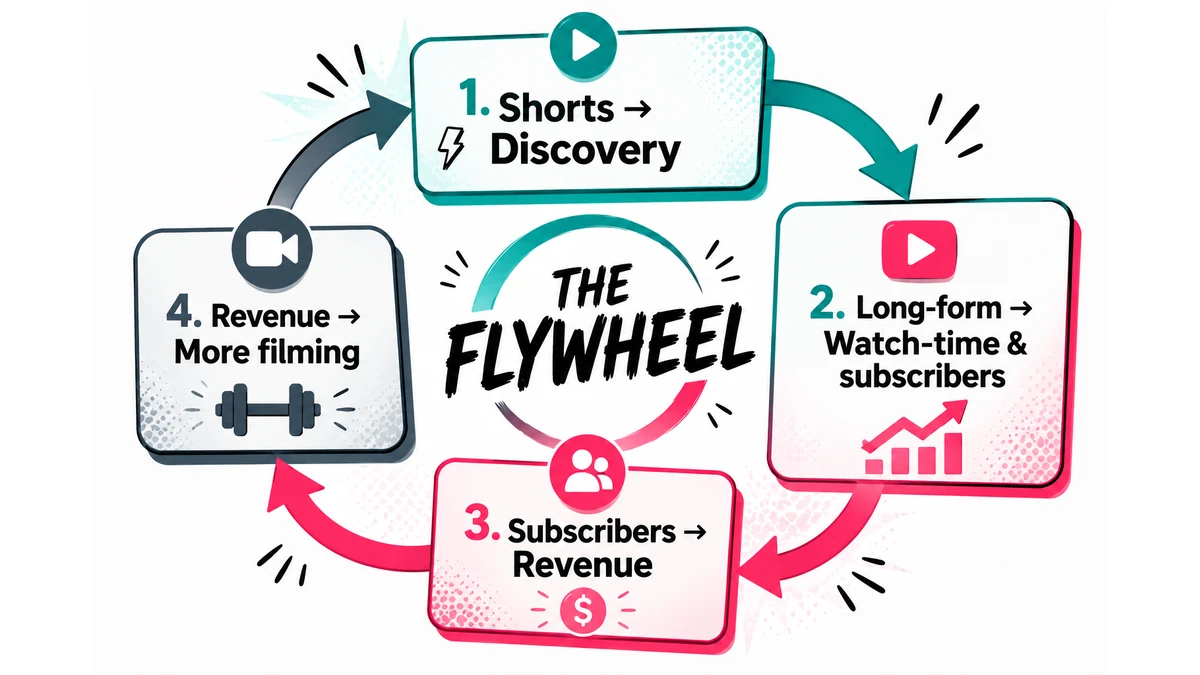
- Shorts do discovery. A 20–45 second clip cut from your workout reaches strangers. Its only job is to get someone to tap your name.
- Long-form does retention. The full follow-along session — 10 to 40 minutes — is where people actually spend time, subscribe, and come back. Watch-time is what the algorithm scores you on, and long-form is where you earn it.
- Retention drives revenue. This is where the two formats split hard. Fitness long-form pays roughly $2–5 per 1,000 views (RPM); fitness Shorts pay closer to $0.15–$0.75 — a 10× to 100× gap. Shorts buy you reach; long-form is where the reach turns into ad revenue, memberships, and an audience you can sell a program to. The long-form is the asset; the Shorts are the funnel into it.
- Revenue funds more filming. Which produces more long-form, which produces more Shorts. The loop compounds.
One honest caveat, because most "post Shorts and blow up" advice skips it: Shorts grow your subscribers, but they don't automatically rank your long-form. In one documented case, a channel hit 500K subs in 18 months with ~99.9% of those subs coming from Shorts — and the Shorts still didn't lift the long-form's search ranking. You feed the funnel with Shorts; you still have to earn each long-form's search position on its own with the title, thumbnail, and chapter work below. Both jobs matter.
The leak almost every solo creator has: they film the long-form and never cut the Shorts, because it feels like a second edit on top of the first. So the top of the funnel stays empty and nothing gets discovered. We'll fix that in the cadence section — the trick is that the Shorts come from the same shoot, not a separate one.
Titles that win fitness search
On YouTube, your title is doing SEO work. Two rules carry most of the weight:
- 50–60 characters total, and your primary keyword in the first ~40 — that's what shows in search and suggested feeds, and it carries the most ranking weight.
- Lead with the search phrase, not the hype. "INSANE 🔥🔥 workout" leads with nothing a person would ever type into the search bar.
A formula that consistently performs for workouts:
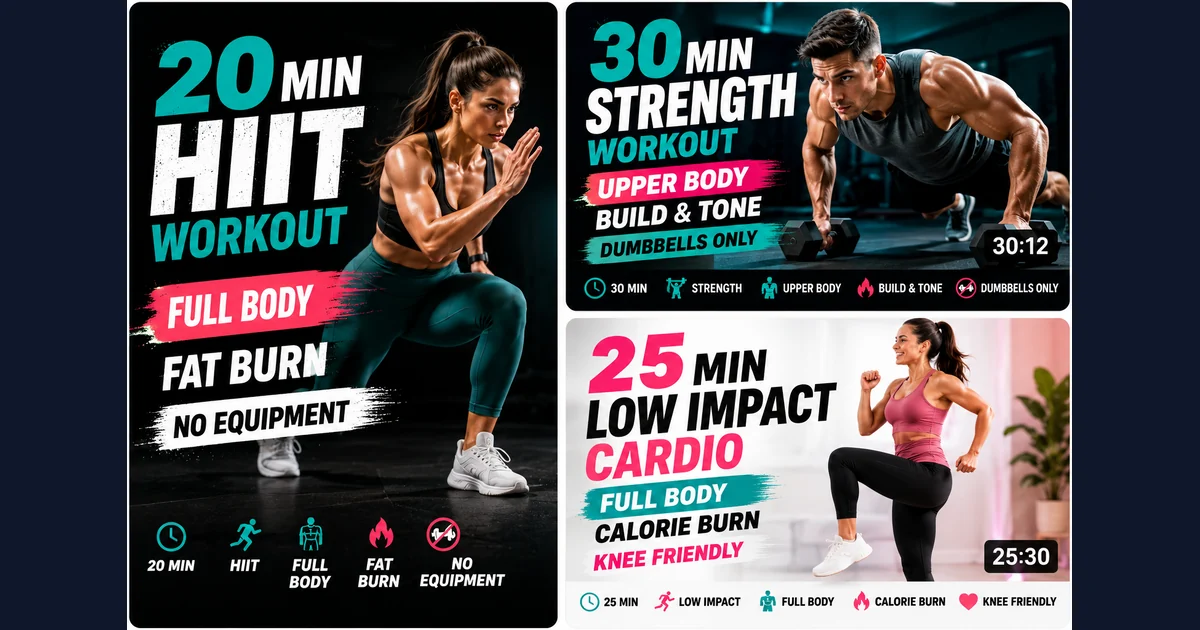
{Duration} Min {Type} Workout – {Body area} {Outcome} ({Constraint})→ "20 Min HIIT Workout – Full Body Fat Burn (No Equipment)"
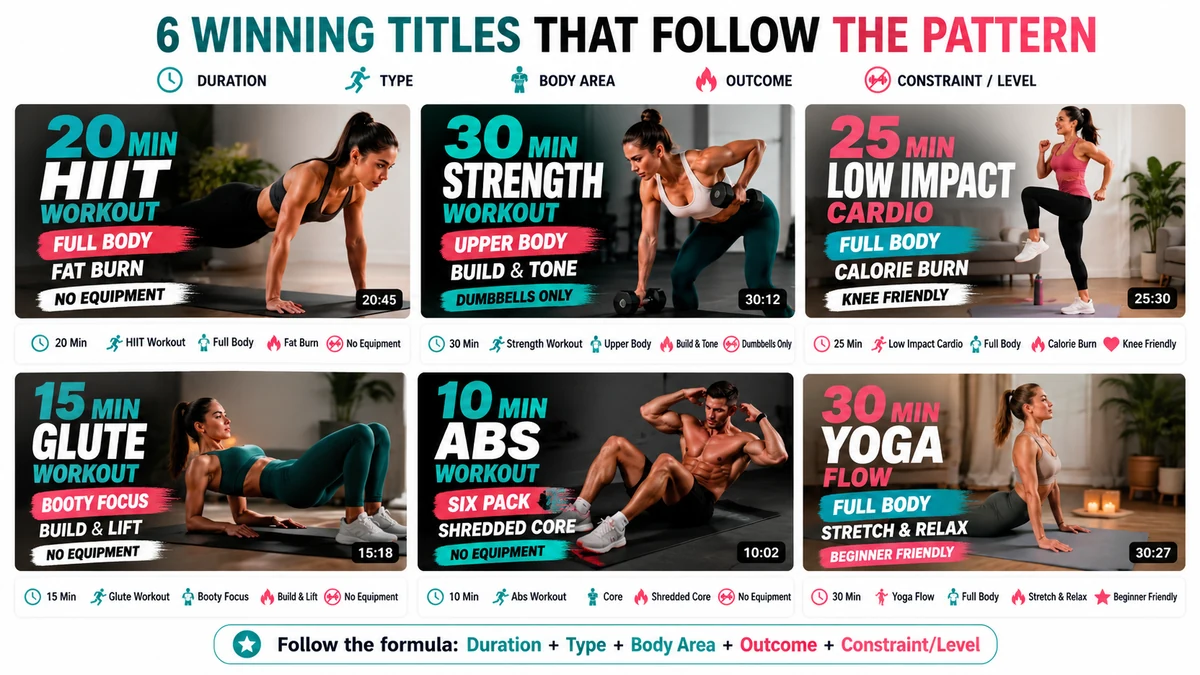
The single highest-leverage words in fitness titles are constraints — "no equipment," "no repeat," "all standing," "apartment-friendly," "low impact," "knee-friendly." They answer "can I actually do this?" in one glance, which is the question every searcher is really asking. Add level ("beginner," "advanced") and, for follow-alongs, experience cues ("to the beat," "with music"). One hype word max — hype plus structure beats hype alone; hype alone loses to the person who just said what the workout is.
Want the field-by-field version — description hooks, hashtag placement, and how Shorts titles differ from long-form? That's covered in Per-Platform Posting Best Practices. This post is the channel-level strategy; that one is the metadata cheat sheet.
Thumbnails: the other half of the click
Title and thumbnail are read as one unit — the title makes the search match, the thumbnail wins the click. For workout videos, the ones that convert share a pattern:
- A real human, mid-movement. Face visible, body in a recognizable position. People click people, and they want to see the level of intensity before they commit.
- 2–4 words of big text that don't repeat the title. If the title says "20 Min HIIT," the thumbnail says "NO EQUIPMENT" or "BEGINNER" — add information, don't echo.
- Consistency across the series. Same font, same frame, same color treatment on every episode. That recognizability is what makes your channel binge-able — viewers learn your thumbnail at a glance and trust the next one.
You don't need a designer. You need a repeatable template you apply to every upload so the channel looks like a channel, not a folder of unrelated clips.
Chapters: turn a workout into a searchable, replayable asset
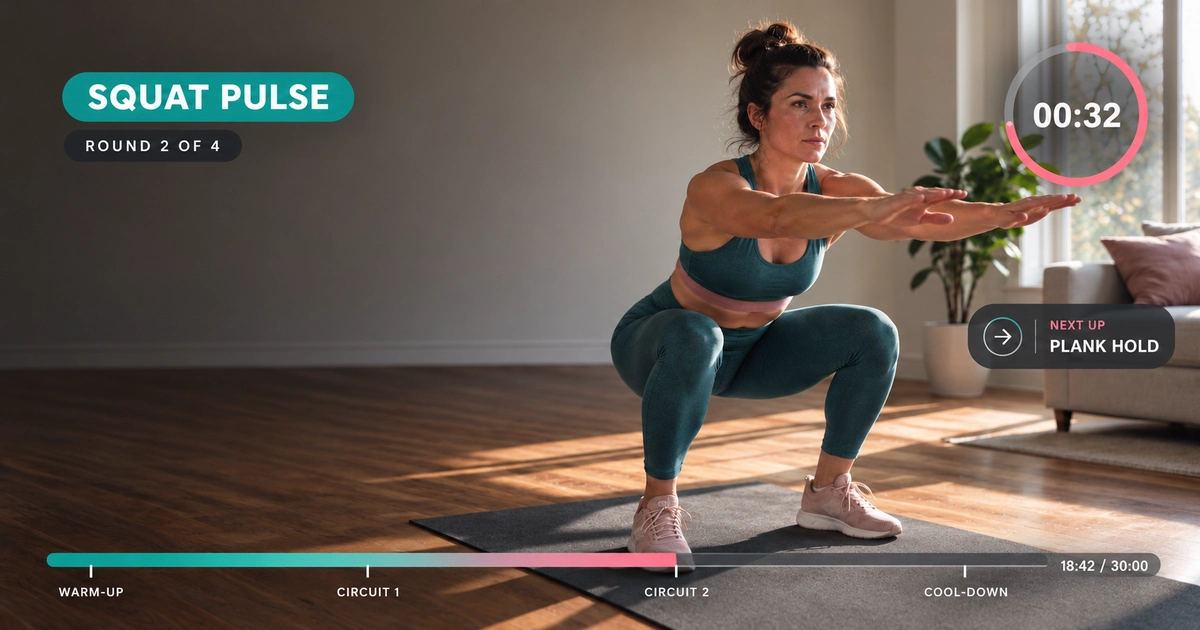
This is the most underused growth lever on the list, and it's free. Chapters (timestamps in your description) turn one video into a set of jump-to key moments — and for a structured workout, that's gold, because people rewatch specific moves.
The format rules are strict but simple. Chapters only render if:
- The first timestamp is
0:00, and - You have at least 3 chapters, each spaced ≥10 seconds apart.
For a follow-along that's natural: Warm-Up, Circuit 1, Circuit 2, Cool-Down.
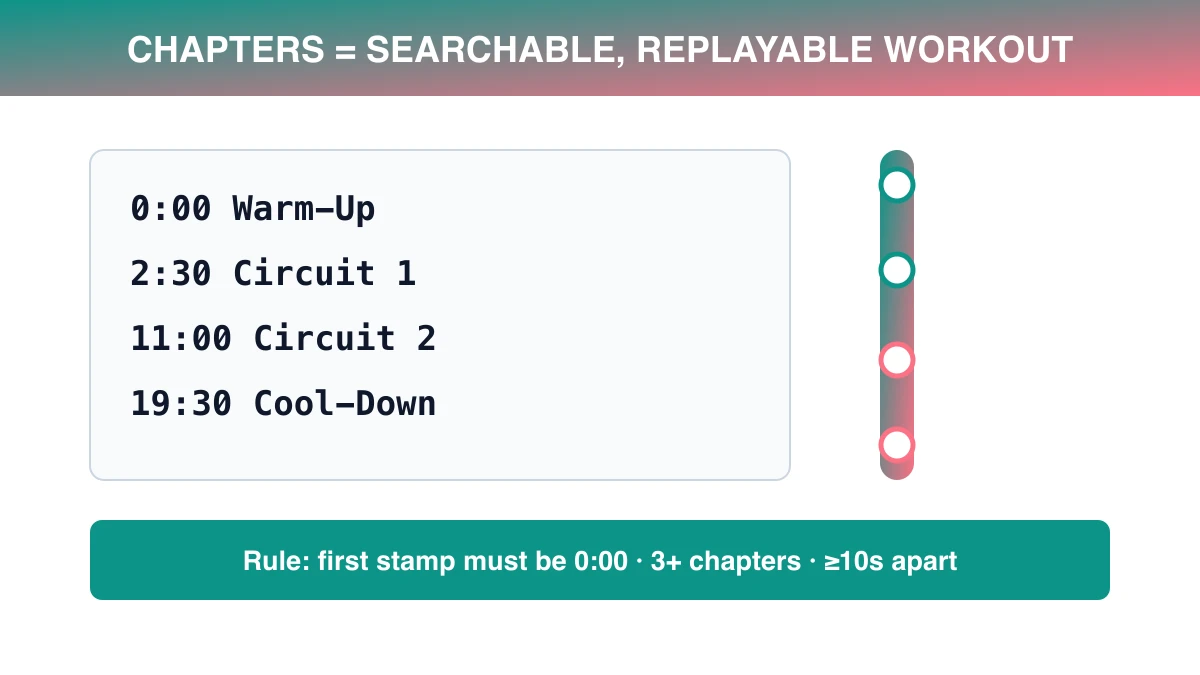
Chapters do three things at once: they cut drop-off (someone who wants the ab section can jump to it instead of leaving), they create searchable key moments YouTube can surface, and they signal a well-structured video. Use them on anything 8–10 minutes or longer. Put them in the description under a hook line (≤120 characters, exact keyword) and one or two benefit paragraphs — the first ~120 characters of your description are the highest-impact real estate, so spend them on the keyword and the payoff, not "hey guys welcome back."
A realistic 90-day plan for one person
Forget "post daily." Here's a cadence a solo coach can actually hold, built around one weekly shoot:
- 1 long-form video per week. Your anchor asset — a complete, chaptered follow-along session. Twelve of these over 90 days is a real, searchable library.
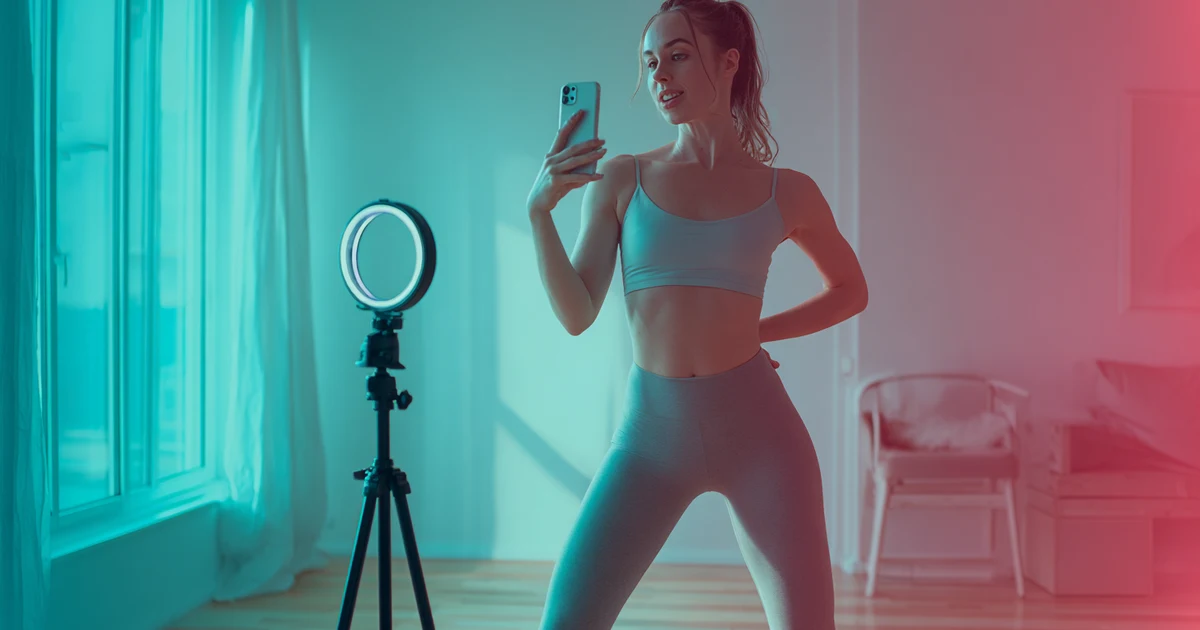
- 3–5 Shorts per week, cut from that same long-form. The single best move in your hook, the hardest interval, a form tip — sliced out and posted vertical. This is your discovery engine, and it costs almost no extra filming — and if cutting those Shorts is the bottleneck, the tools that automate it start on a free plan.
- One keyword per video, decided before you film. "Beginner 15-minute dumbbell full body" shapes the title, the thumbnail text, the description, and the Shorts. Decide it once; reuse it everywhere.
Ninety days of that is ~12 long-form assets and ~40–60 Shorts, all pointing at each other. That's not a viral gamble — it's a library that keeps getting found. The creators who grow this way say the same thing: consistency beats virality. One coach recently documented going from 35K to 45.4K followers and 1.2M views in eight weeks — not from a single hit, but from finally running a repeatable content system instead of posting at random.
Time it to the calendar, too. Fitness is deeply seasonal — average views across fitness creators jump about 55% in January versus other months. Batch and front-load your strongest long-form sessions for late December and January, when resolution-season search demand is at its peak.
A word on sustainability: the real failure mode for solo creators isn't the algorithm, it's burnout. "Two Shorts a day and a long-form a week" is a common target, but a schedule you can hold for a year beats a heroic month followed by silence — the whole point of building a searchable library is that it keeps working on your rest days. Results and timelines vary from person to person and niche to niche; the point isn't a subscriber guarantee, it's building the compounding base that makes growth possible.
One shoot, a week of content
The whole plan only survives if the Shorts don't become a second job. They shouldn't — they live inside the long-form you already filmed. Film the session once, then:
- Pull 3–5 strong 20–45s moments for Shorts (best hook, peak effort, a single clean cue).
- Cut the full session into your chaptered long-form.
- Reuse the one keyword across all of it.
That's the repurposing muscle worth building — and it's the exact workflow we're building for fitness creators. If you want the step-by-step for slicing a long workout into vertical clips that actually get saved, we broke it down here: How to Turn Workout Videos Into Reels.
The one-screen checklist
Keep this next to your editing setup:
- ✅ Pick one keyword before filming — it drives the title, thumbnail, and Shorts.
- ✅ Title: 50–60 chars, keyword in the first 40, constraint + level named.
- ✅ Thumbnail: real human mid-move, 2–4 words that add info, consistent template.
- ✅ Chapters on anything 8+ min — start
0:00, 3+ stops ≥10s apart. - ✅ Description: keyword + payoff in the first ~120 chars, then benefits, then chapters, then 3–5 hashtags at the bottom.
- ✅ Cadence: 1 long-form/week + 3–5 Shorts cut from it.
- ✅ Every Short points home — a reason to tap through to the full session.
That's the flywheel: Shorts open the door, long-form keeps people in the room, chapters make it worth staying, and the whole library keeps getting found long after you posted it. The trainers whose channels compound aren't filming more than you — they're just letting one shoot do the work of ten.
ActiveSnap is building exactly that one-shoot-to-a-week workflow for fitness creators — if you want to try it, start free.
A note on claims: fitness results vary, and so does channel growth. Describe what a workout is and who it's for; avoid promising specific fat-loss or subscriber outcomes. This isn't just good taste — YouTube's 2026 medical-misinformation policy can pull monetization from health content that contradicts mainstream health authorities, so "lose 10 lbs in a week" is a monetization risk as much as a trust one. Honest framing wins on both fronts.
Cutting the Shorts, writing chapters, and keeping a series' branding consistent across every episode is exactly the busywork that makes creators skip the flywheel. Plenty of people lean on templates — or tools that can auto-detect a workout's segments and turn them into chapters and clips — so one shoot really does become a week of content. However you do it, the strategy above is what you're optimizing for.