How much does TikTok pay a fitness creator for having a million followers? Nothing — followers alone earn $0. TikTok doesn't publish payout rates, but industry trackers consistently estimate its Creator Rewards Program pays roughly $0.40–$1.00 per 1,000 qualified views, so an account only earns while its videos keep performing. That single fact explains more about making money creating fitness content than any "how I hit six figures" video ever will.
So — can you really make money creating fitness content? Yes. Trainers and creators are building real incomes from it in 2026. But almost none of that money comes from where beginners point their effort: views, followers, and platform payouts. It comes from what the content sells. Here's the actual math, the streams that pay, and what a realistic first year looks like.
Subscribers don't pay you — and views pay less than you think
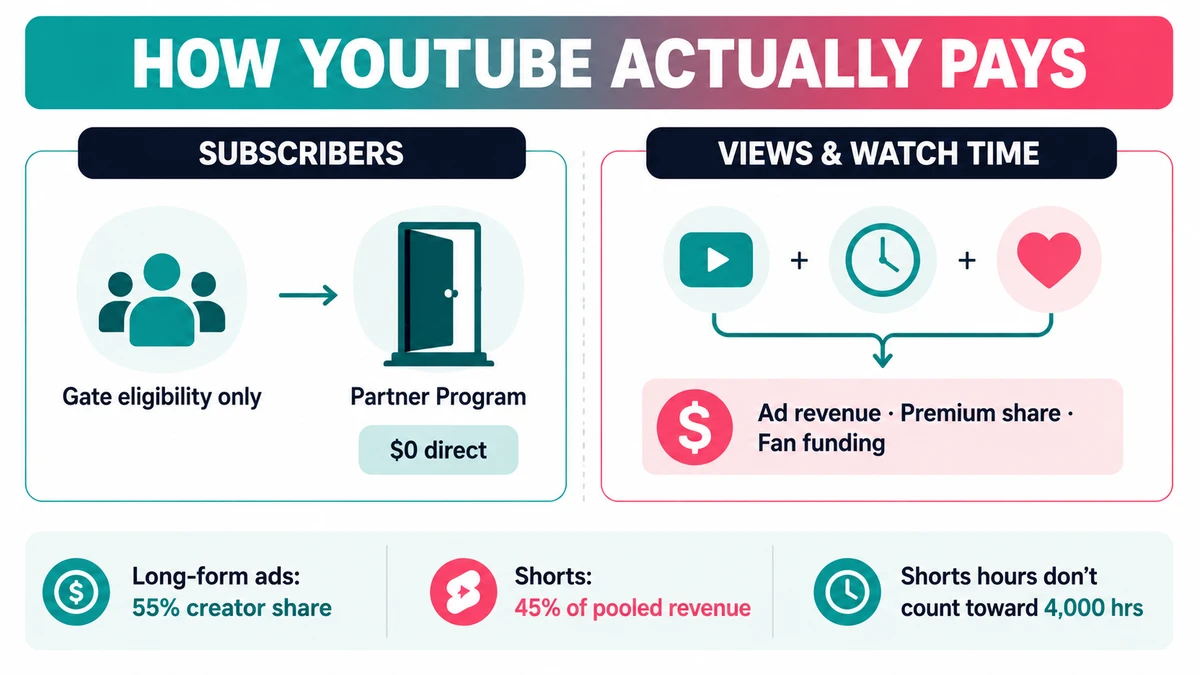
The most persistent myth in fitness content is that some follower or subscriber count unlocks an income. It doesn't. Subscriber counts pay $0 directly. On YouTube, subscribers only gate your entry into the YouTube Partner Program and its features. The money itself comes from monetized ad views, YouTube Premium watch-time share, and fan funding.
As of 2026 the Partner Program has two tiers:
| Tier | Requirements | What it unlocks |
|---|---|---|
| Fan funding | 500 subs + 3 public uploads in 90 days + (3,000 watch hours in 12 months OR 3M Shorts views in 90 days) | Memberships, Super Chat/Thanks, Shopping — no ad revenue |
| Full ad revenue | 1,000 subs + (4,000 public watch hours in 12 months OR 10M Shorts views in 90 days) | Ad + Premium revenue share |
Two details trip up fitness creators specifically:
- Shorts watch time doesn't count toward the 4,000 long-form hours. The two eligibility paths are separate — a Shorts-only strategy has to clear 10M views in 90 days.
- Shorts have no per-video CPM. All Shorts ad revenue is pooled per country, music licensing is deducted, the pool is split by each creator's share of engaged views, and you keep 45% of your slice. Long-form pays a straight 55% share of the ads your videos run.
That pooling is why the numbers are so small. Fitness Shorts RPM runs about $0.06–$0.15 per 1,000 views globally (the all-niche US average sits around $0.33). Long-form fitness RPM is better — plan around $2–$7 per 1,000 views — but at a $4 RPM you need 100,000 monthly views to make $400. TikTok's Creator Rewards is built the same way: payment per qualified view, nothing per follower — which is why payout screenshots from big accounts so often disappoint.
Ad revenue is a bonus check, not a salary. Which raises the obvious question: where does the real money come from?
Where fitness creators actually make money in 2026
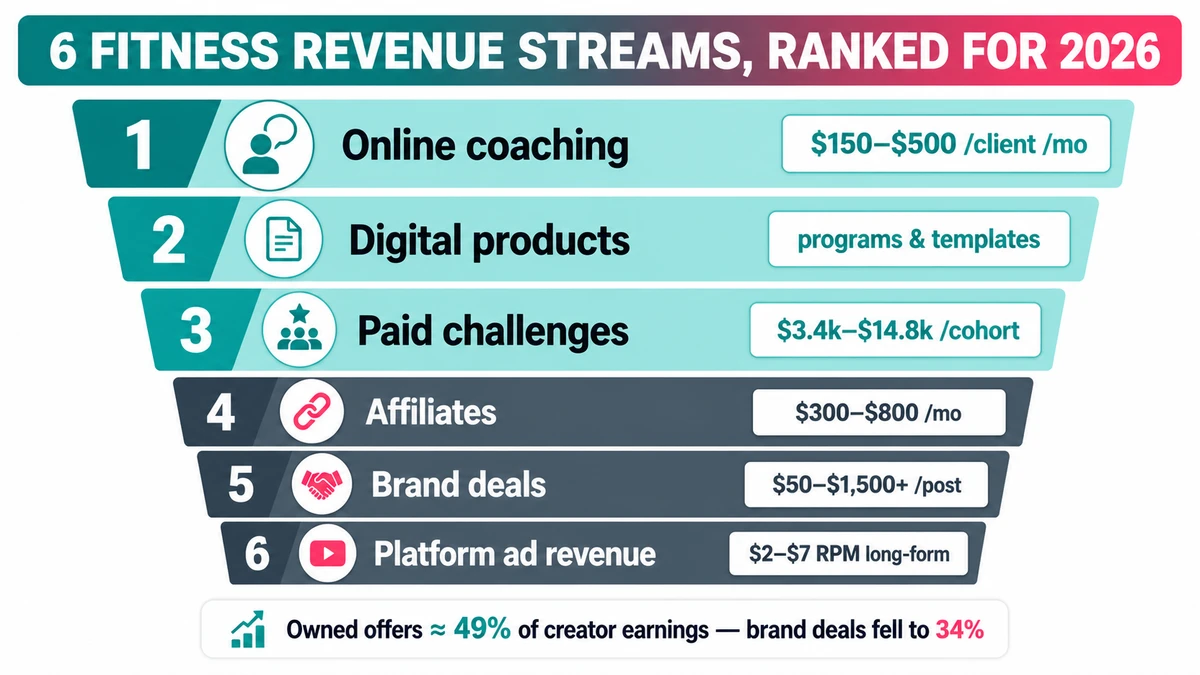
The sponsorship era faded faster than most creators noticed. One 2026 industry benchmark puts brand deals and ad revenue at roughly 34% of fitness-creator earnings, down from about 60% two years earlier, with owned offers — coaching, digital products, and paid challenges — now around 49% (CommuniPass benchmarks). Single-vendor numbers deserve a grain of salt, but the direction matches what working trainers describe everywhere.
There's a structural reason. Trainers who chased brand deals describe the same frustrations: late payments, low flat fees, endless revision rounds. Meanwhile fitness monetizes something most niches can't — trust that converts to services. A coach with 50,000 engaged followers can out-earn a fashion creator with 100,000, because the fitness audience will buy coaching, not just tap a discount code.
Here's how the six streams stack up for a solo trainer or creator, ranked by how realistic they are at small-to-mid audience sizes:
- Online coaching — the fastest path to real income. 2026 pricing runs $150–$500/month for 1:1 and $50–$150/person/month for group coaching. Twenty clients at $200/month is $4,000/month with zero brand deals — reachable at follower counts that pay pennies in ad revenue. Certifications carry a premium ($95–$350/hr for credentialed specialists vs $75–$200 general).
- Digital products — programs, templates, meal-planning guides. Sell while you sleep, but only after you've built trust; creators in the 50k–500k range report meaningful monthly revenue here.
- Paid challenges — time-boxed 4–8 week cohorts. By one 2026 benchmark, the median 50k-follower fitness creator running a quarterly challenge clears $3,400–$14,800 per cohort. High energy, high churn, great cash-flow spikes.
- Affiliates — supplement and equipment links typically add $300–$800/month for micro creators. The viral "passive bio-link income" screenshots you see on X are outliers, not a plan.
- Brand deals — real but back-loaded: 2026 rate cards put nano creators (1k–10k) around $50–$200 per post (some as high as $600 for engaged fitness audiences), micro creators at $300–$1,500+, and the $10k+ integrations only arrive with scale and a track record.
- Platform ad revenue — the math above. Treat it as a rounding error until you have serious long-form watch time.
A realistic stack for a micro fitness creator (10k–50k followers) combines several of these: a couple of brand deals, ~10 coaching clients, some program sales, and affiliate income — landing in the $3,800–$7,800/month range once every stream is running (Rupa's 2026 guide). Not a Lambo. A real income.
How long until the first dollar?
Slower than the highlight reels admit. In the largest recent creator survey (3,000+ creators, NeoReach × Influencer Marketing Hub, 2025), more than half of creators earned under $15,000 for the year from their content — and in a separate late-2025 survey, nearly half earned less than $500 all year. Platform payouts arrive late and small, and sponsors want a track record before they call.
The creators who beat those odds share one trait: they sell something from day one. A trainer with a coaching offer doesn't need to wait for Partner Program thresholds or inbound sponsors — the content is the storefront, and the first client can arrive in week one. Content-first creators wait for the platforms to pay; coaching-first trainers use the platforms as free marketing. Same videos, different business.
That's also the honest caveat: these are gross numbers. Filming gear, software, certifications, and your time come out of every figure above, and incomes vary widely — results depend on niche, consistency, and offer quality far more than follower count.
Will AI-edited videos get you demonetized?
A worry worth retiring. In July 2025, YouTube renamed its "repetitious content" monetization rule to "inauthentic content" — and creators read it as an AI ban. It isn't. The policy targets mass-produced spam: near-identical templated uploads and low-value AI slideshow channels, with enforcement at the channel level.
For a fitness creator the line is clear. Using AI to edit real filmed workouts — cuts, pacing, captions, thumbnails — is production assistance. YouTube's own exemption list covers scripts, thumbnails, captions, filters, and background effects: no disclosure, no monetization risk. The disclosure rule only kicks in for realistic synthetic or altered content that could be mistaken for the real thing — a photoreal AI trainer demonstrating a workout that never happened needs a label; your AI-captioned squat tutorial doesn't. Film real workouts and edit them freely — the only edit that needs a label is one that makes footage show something that never actually happened.
A realistic 12-month plan
If you're starting from a small audience, sequence it like this:
- Months 1–3: Build the engine. Pick one primary platform plus YouTube, post 3–5x/week, and put an offer in your bio from day one — even a simple "DM me for coaching." Don't wait to be "big enough."
- Months 4–6: First clients. Convert your most engaged followers into 5–10 coaching spots. Expect your first content dollars around now — coaching income should already be multiples of it.
- Months 7–9: Productize. Turn your most-asked question into a paid program or template. Run your first small paid challenge with the audience you've earned.
- Months 10–12: Stack and prune. Add affiliates for gear you genuinely use, take brand deals only at rates that beat an hour of coaching, and double down on the two streams that actually paid.
The volume this plan demands is the real constraint — consistent multi-platform posting is where most solo trainers burn out. Batching content and leaning on editing tools (AI editors like ActiveSnap can turn one filmed session into a week of platform-ready posts) is how one person sustains the cadence without hiring an editor.
If you're building the audience side in parallel, start with how to grow a fitness YouTube channel and per-platform posting best practices — and when filming feels like too much output, turn one workout into a week of Reels.
The bottom line: yes, you can really make money creating fitness content — just not from the views themselves. The content earns attention; the offer earns the income. Save this plan, pick your offer, and start the clock.