Fitness video retention is the number most creators read wrong. A 30-minute follow-along and a 10-minute explainer are not competing on the same scale — and the format that looks worse on a retention graph is often the one banking more watch time. The percentage is not the prize. The minutes are.
Here is the arithmetic, the four production leaks that hand those minutes back, and what changes when your vertical is Pilates instead of HIIT. We measured the leaks across 32 of the most-watched follow-alongs on YouTube, so the numbers below are ours rather than borrowed.
Why fitness video retention looks worse than it is
There are two numbers here, and creators routinely collapse them into one word.
- Average view duration — in YouTube's own words, the "average minutes watched among those who stayed to watch," calculated from engaged views and their corresponding watch time. It is denominated in minutes.
- The percentage you quote — "my retention is 40%" — is that same duration divided by the video's length. It is denominated in percent, and it therefore falls as your video gets longer even when nothing about the viewing gets worse.
That second point is arithmetic, not opinion. Run two ordinary performances:
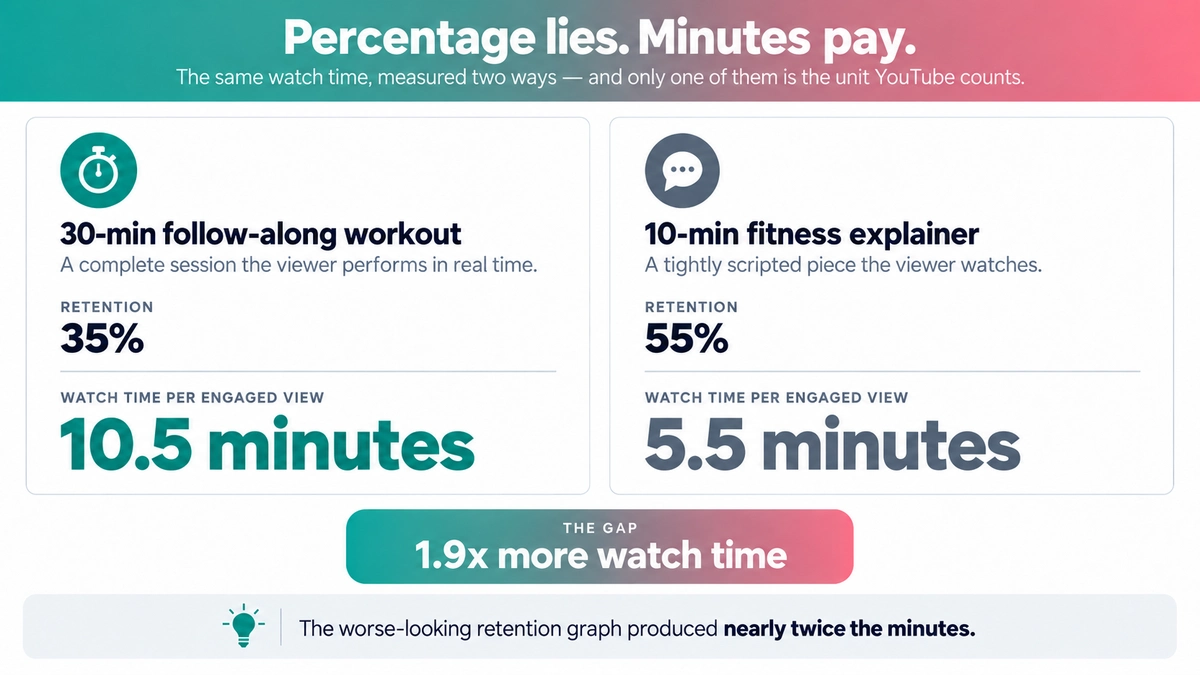
The 30-minute session held to 35% delivers 10.5 minutes per engaged view. The 10-minute explainer held to a much healthier-looking 55% delivers 5.5. The video with the worse graph produced roughly 1.9× the watch time.
Minutes are also the unit YouTube itself bills in. Getting into the Partner Program at all requires "1,000 subscribers with 4,000 qualified watch hours in the last 12 months" — hours, not percentages. Subscribers gate the door; watch time is what you actually accumulate.
You will find "good retention" bands all over the web — 30–50% for a 15–30 minute video, depending which creator blog you land on. Treat them as folklore: they disagree with each other, and none of the ones we found publishes the dataset behind the number. Your comparison set isn't a stranger's percentage. It's your own minutes, last month.
Why do follow-along workouts get more watch time?
Follow-along has a structural property most fitness formats don't: the viewer is doing the thing. They are on a mat, mid-set, hands occupied. Skimming isn't free — skip ahead and you lose your place in a session you are physically inside.
Which cuts both ways. A viewer who quits a follow-along usually isn't skipping to a better bit; they've stopped exercising. That makes every leak below expensive in a way it wouldn't be in a talking-head video, where a bored viewer scrubs forward and keeps watching.
(How long should the session be? Long enough to be a complete workout and no longer — the length the title promised. That's a topic of its own.)
We tore down 32 popular follow-alongs
Retention data is private: nobody outside a channel can see its average view duration. But the causes are public, so we measured those instead.
We pulled 32 follow-along workout videos from 22 channels — 10 to 38 minutes each, every one above 50,000 views, 177.6 million views between them, published between January 2023 and February 2026, capped at two videos per channel so no single creator drove the result. Candidates that turned out to be explainers or programming walkthroughs rather than sessions were dropped after reading their opening transcripts.
Then we measured what you can see from outside a channel: how long the creator talks before the first movement, whether the video ships chapters, how often the creator signals what's coming next, and — from the transcripts — the coaching language each vertical actually uses.
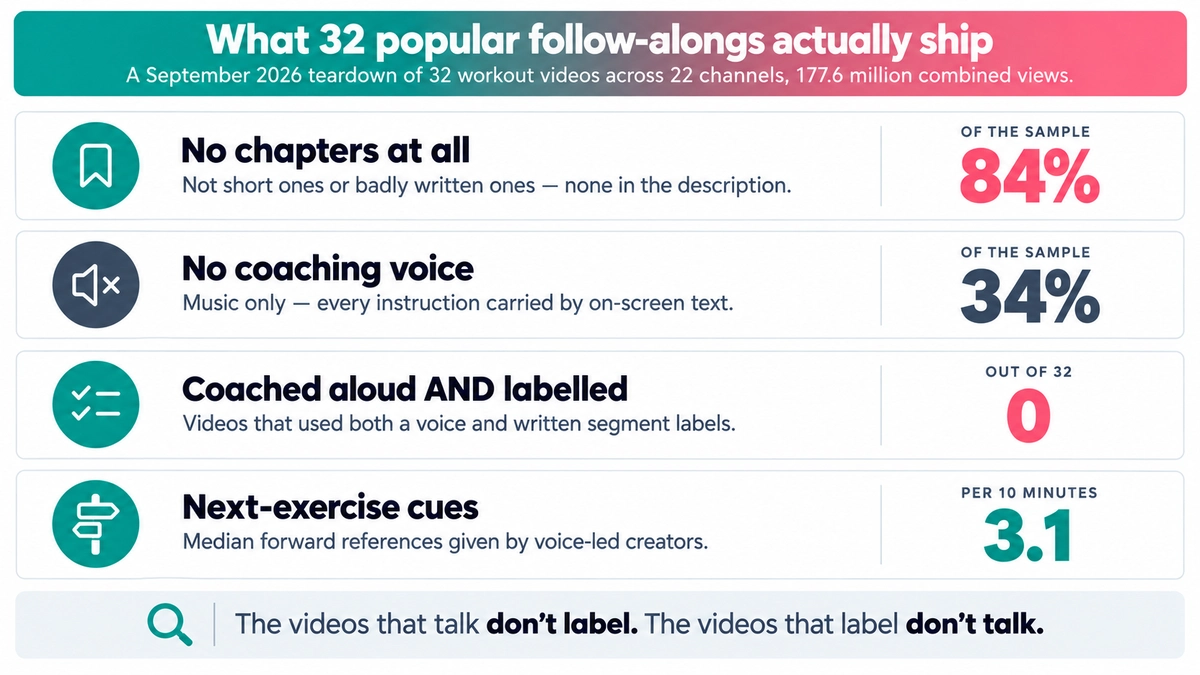
The headline: 27 of the 32 ship no chapters at all. And the split underneath that number is the part we didn't expect.
The videos that talk don't label. The videos that label don't talk.
Two thirds of the sample (21 of 32) are voice-led — the creator coaches out loud. The other third (11 of 32) are silent: music only, every instruction carried by on-screen text.
- 0 of 21 voice-led videos had chapters.
- 5 of 11 silent videos had chapters — one 34-minute dumbbell session was broken into 41 labelled segments.
- 0 of 32 did both.
Creators who removed their voice replaced it with structure. Creators who kept their voice seem to have assumed the voice was enough. A spoken cue only exists in the second it's said: it puts nothing on the progress bar, and gives a viewer hunting for your shoulder block nothing to aim at. Chapters, in YouTube's description, break a video into sections "each with an individual preview" so viewers can "easily rewatch different parts."
Nobody in our 32 did both. That's a wide-open gap.
Every vertical leaks differently
Splitting the sample by discipline was where it got interesting. These are small groups — three to ten videos each — so read them as signatures, not laws:
| Vertical | n | Voice-led | Chapters | Median length | Intro | "Next" cues /10 min |
|---|---|---|---|---|---|---|
| Pilates | 4 | 2 | 0 | 19 min | 21s | 5.4 |
| Yoga | 3 | 3 | 0 | 19 min | 19s | 3.2 |
| Walking | 5 | 5 | 0 | 26 min | 23s | 2.8 |
| HIIT / Cardio | 5 | 2 | 2 | 15 min | 11s | 1.2 |
| Dumbbell / Strength | 5 | 3 | 1 | 23 min | 31s | 1.3 |
| Bodyweight / Core | 10 | 6 | 2 | 17 min | 40s | 4.5 |
Three things fall out of that table.
HIIT is the on-screen-text vertical. Three of five HIIT videos had no coaching voice at all, and it's one of only three verticals where anyone shipped chapters. It makes sense: intervals are self-describing. A timer and an exercise name on screen tell you everything a voice would, and the format's whole appeal is that you don't have to listen — you just follow the clock.
Yoga, Pilates and walking are voice-led and completely unlabelled. All 12 videos across those three verticals: 10 voice-led, zero chapters between them. These are formats where the instruction genuinely lives in the voice — a breath cue can't be replaced by a caption — so the reflex to skip on-screen structure is understandable. But chapters aren't overlays. They're a table of contents, and a 26-minute walking session is exactly the kind of video someone returns to and wants to re-enter halfway.
Walking has the most on the table. It's the longest format in the sample at a median 26 minutes, so it has the highest watch-time ceiling of any vertical here — and it's 5-for-5 on no chapters, with next-cue density near the bottom of the table. The format with the most minutes to win is the one leaking navigation hardest.
The four leaks — and what each one costs
YouTube's own audience retention report names four shapes you'll see in your graph, and they map onto these leaks almost one to one: flat lines mean "viewers are watching that part of your video from start to finish," gradual declines mean "viewers are losing interest over time," dips mean "viewers are abandoning or skipping at that specific part," and spikes appear "when more viewers are watching, rewatching, or sharing those parts."
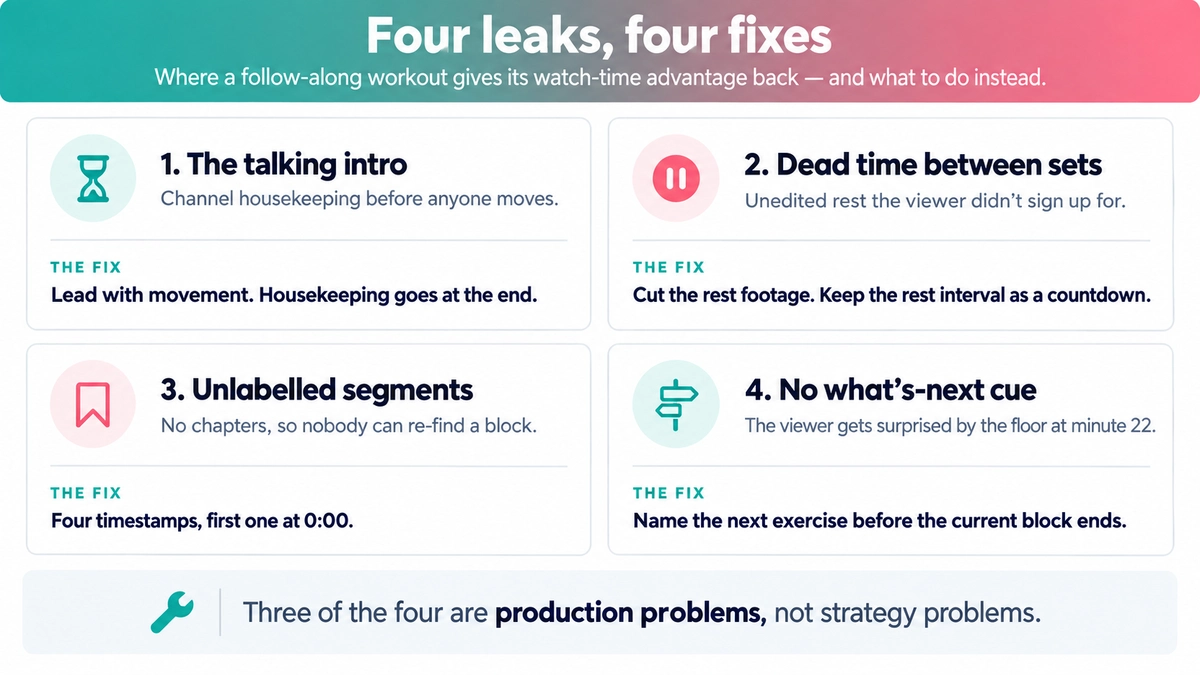
1. The talking intro before the first movement
Across the voice-led videos where we could time it, the median gap between "play" and the first movement cue was 23 seconds. But the tail is long: 9 of 19 talked for more than 30 seconds, three went past a minute, and two spent roughly four minutes before anyone moved.
Thirty seconds is not an arbitrary line. YouTube reports a metric called Intro, which "tells you what percentage of your audience still watched your video after the first 30 seconds" — the platform is explicitly scoring your opening half-minute. Note the per-vertical spread: HIIT gets moving in 11 seconds, strength takes 31, bodyweight/core takes 40.
Fix: first movement inside 30 seconds, housekeeping at the end. Warm-up is content — start it, then talk over it if you must talk.
2. Dead time between sets
We could not measure this one from outside, and we'd rather say so than invent a proxy: caption silence in a workout video is indistinguishable from music, so a transcript can't tell an unedited rest period from a set performed to a beat.
What we can say is where to look. Unedited rest doesn't usually produce a cliff, it produces the shape YouTube calls a gradual decline — the slow taper of viewers "losing interest over time." That one you can see in your own analytics tomorrow.
Fix: cut the rest to the rest interval, not the rest footage. A 40-second rest becomes a 40-second countdown on screen, not 40 seconds of you catching your breath. The offcuts aren't waste, either — they're raw material for turning the session into Reels.
3. Unlabelled segments
27 of 32 videos — 84% of the sample — ship no chapters. YouTube's rule is not demanding:
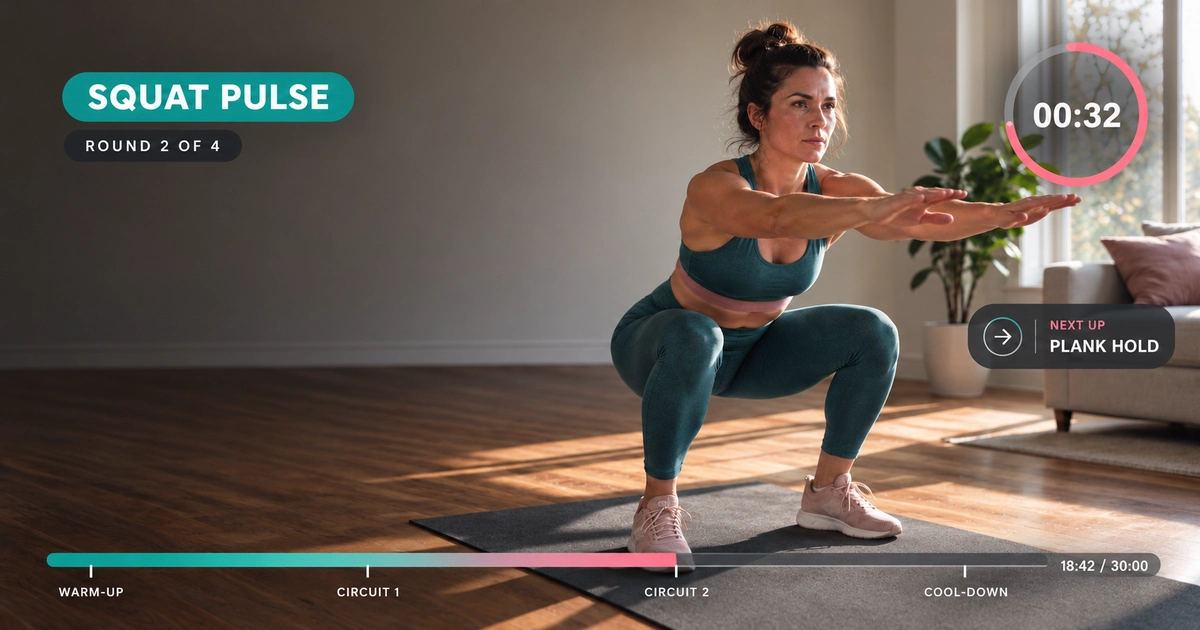
the first timestamp must be 00:00, you need at least three in ascending order, and each
chapter must run at least 10 seconds. A follow-along clears that by accident — warm-up,
circuit one, circuit two, cool-down is four.
The five videos that did label went much further than the minimum, running roughly one to two segments per minute — a 14-minute session with 29 marked blocks, a 34-minute one with 41. They're treating the description as a contents page, not a formality. The mechanics of writing chapters are in our guide to growing a fitness YouTube channel; what this teardown adds is that almost nobody is doing it.
Fix: four timestamps, minimum. It is the cheapest item on this list by a distance.
4. No "what's next" cue
Voice-led creators gave a median of 6 forward-looking cues per video — "next up," "coming up," "last one" — about 3.1 per 10 minutes. For scale, the creators who do label their videos mark one to two segments a minute, so a three-cues-per-ten-minutes video is signposting a small fraction of its own transitions.
The spread by vertical is wide: bodyweight/core and Pilates creators cue constantly (4.5 and 5.4 per 10 minutes), HIIT and strength barely at all (1.2 and 1.3). For HIIT that's arguably fine — the on-screen timer is doing the job. For strength, where the next move might need different equipment, it's a genuine gap.
Fix: name the next exercise before the current one ends — out loud, on screen, or both. Both is the option nobody in our sample took.
What actually makes a follow-along pop
Structure keeps people in the room. It isn't what makes them come back. So we ran the transcripts of the 21 voice-led videos for the coaching devices creators actually use, as a rate per 1,000 spoken words. Every vertical has a signature:
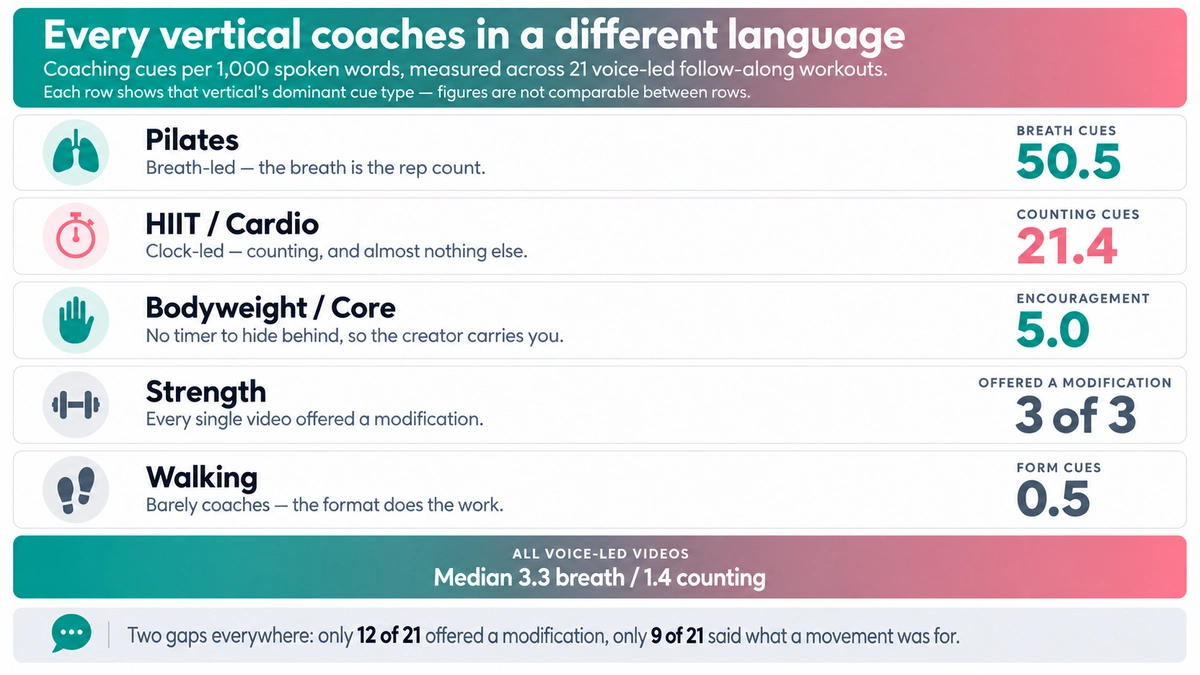
- Pilates is breath. 50.5 breath cues per 1,000 words — more than fifteen times the all-video median of 3.3. The breath is the rep count.
- HIIT is the countdown. 21.4 counting cues per 1,000 words against a 1.4 median. Almost nothing else: no breath work, no form talk. Pure clock.
- Bodyweight and core run on encouragement (5.0 per 1,000, the highest), because there's no equipment and no timer to hide behind — the creator is the only thing carrying you.
- Strength leads on modifications — the only vertical where every voice-led video offered one — and sits second on form cues (3.8, behind Pilates' 4.9). Load makes both non-negotiable.
- Walking barely coaches at all. Almost no form talk, and only one of five videos offered a modification. The format does the work; the voice is company.
Copying another vertical's signature is how a workout video ends up feeling generic. A Pilates class that counts like a HIIT session loses what people came for.
Two gaps show up across the whole sample, though, and both are cheap to close:
- Only 12 of 21 voice-led creators offered a modification at all. For a beginner, the moment they can't do the movement is the moment they leave — and a single "if that's too much, do this instead" keeps them in the session.
- Only 9 of 21 ever said what a movement was for. "This one's going to light up your glutes" costs three seconds and converts a rep into a reason.
One honest negative. We checked whether any of this shows up in public engagement, and it doesn't. Median like rate was 1.78% of views across the sample, and the gaps were noise — 1.82% for voice-led against 1.73% for silent, and 1.73% for chaptered videos against 1.80% for unchaptered. With 32 videos and only five of them chaptered, that is not evidence chapters hurt; it's evidence that likes measure something else. Structure is a watch-time lever, not a popularity one, and we'd rather tell you that than dress up a coincidence.
The one-screen checklist
Before you publish the next follow-along:
- First movement inside 30 seconds — the window YouTube itself scores.
- Rest cut to the interval, not the footage — countdown on screen.
- At least four chapters, first at
0:00. Especially if you're voice-led, where nobody in our sample bothered. - The next exercise named before the current block ends — spoken and on screen.
- One modification offered per hard movement, and one reason per block.
- Play to your vertical's signature — breath for Pilates, the clock for HIIT, form and equipment cues for strength — instead of borrowing someone else's.
- Track average view duration in minutes, month over month, against your own channel. Ignore the percentage when comparing across lengths.
Three of those leaks are production problems rather than strategy problems, which is inconvenient, because production is the part that eats the day.
Trimming rest between sets, putting a next-exercise preview on screen, and labelling every segment are three separate hand passes over the same 30-minute timeline. That's the job tools like ActiveSnap take on: it detects every exercise in the raw footage, so those edits become instructions instead of manual cuts, and the detected segments carry straight out as chapter labels for YouTube. It's built for the interval-and-equipment formats — HIIT and dumbbell strength — rather than for breath-led yoga and Pilates, where the coaching lives in the voice and a label adds little. (We build it, so weigh that accordingly; the leaks above are worth fixing by whatever method you like.)
The takeaway
Follow-along workouts win on minutes, not percentage — a 30-minute session at 35% retention out-earns a 10-minute video at 55%, and creators optimising the percentage are optimising against their own format. Judge your videos on average view duration in minutes, against your own channel's history. Then go get the minutes back: lead with movement inside 30 seconds, cut the dead air, label the segments, tell people what's coming, and coach in your own vertical's language. Out of 32 of the most-watched follow-alongs on YouTube, not one did all of it.
Our teardown describes 32 videos collected in September 2026 — a snapshot, not a universal rule, and the per-vertical groups are small. Retention and earnings vary by channel, niche and audience location.