You don't need a better camera, a bigger following, or the perfect niche to become a fitness content creator. You need to start this week. The most expensive thing a beginner does is wait — for gear, for a whim of inspiration, for permission — while the creators who started messy six months ago now have an audience and a first paycheck.
This is the honest roadmap: six steps to go from zero to a real fitness content practice, plus the timeline nobody puts in the highlight reel. None of it requires money you don't have. Most of it you can start today with the phone in your pocket.
Step 1: Pick a niche narrow enough to feel uncomfortable
"Fitness" is not a niche — it's an industry with millions of creators. The fastest way to stall is to be the 400,000th account posting generic full-body workouts. The fastest way to grow is to be the person for a specific someone.
A niche worth committing to sits at the intersection of three things:
- An audience — who, specifically? "Busy parents," "women over 50," "desk workers with back pain," "guys getting back in the gym after a decade off."
- A modality — kettlebells, mobility, running, calisthenics, postpartum rehab, powerlifting.
- An outcome — the result they actually want: pain-free mornings, a first pull-up, staying strong through menopause.
Stack all three and you get "mobility for desk workers who wake up stiff" instead of "fitness." It feels almost too narrow — that's the signal you've found it. You can always widen later; you can't stand out by starting broad.
One shortcut from creators who've done it: pick the niche you already spend money in. As one fitness UGC creator put it on X, "You know the products, the language, and what convinces you to buy. That fluency shows up on camera." Your own training obsession is a head start you're ignoring.
Step 2: Film with the phone in your pocket
Here's the permission you're waiting for: your smartphone is enough. A veteran creator's line on X sums up the trap — "Waiting on a better camera is the most expensive delay… I filmed my first paid videos on a cracked iPhone by a window."
What actually moves the needle isn't the camera — it's audio. Viewers forgive average video; they scroll away from bad sound. Gear guides are blunt about the priority: upgrade your microphone before your camera — it's the single change that most improves whether people keep watching. A phone paired with a ~$30 clip-on lavalier mic and a cheap tripod will out-produce most new channels.
Your entire starter kit, in priority order:
- The phone you own — shoot in the highest resolution it offers.
- A clip-on/lavalier mic (~$30) — one that stays put while you move. For fitness specifically, a wireless clip-on that survives burpees is worth it.
- A tripod ($15–$30) — stable framing reads as "professional" more than 4K does.
- Light — stand facing a window for free, or add a ~$30 ring light for evenings.
You can build a genuinely good setup for around $150; most creators who upgrade later spend $300–$500 — after the channel earns it, not before. Buy the mic. Skip the rest for now.
Step 3: Make content people follow, not just watch
A feed of nothing but workout demos makes you replaceable — there are a thousand of them. The creators who build loyalty use the workouts as a stage. As creator Megan put it on X, "The ones who use fitness to talk about discipline, failure and identity build real loyalty." People follow a person, not a rep count.
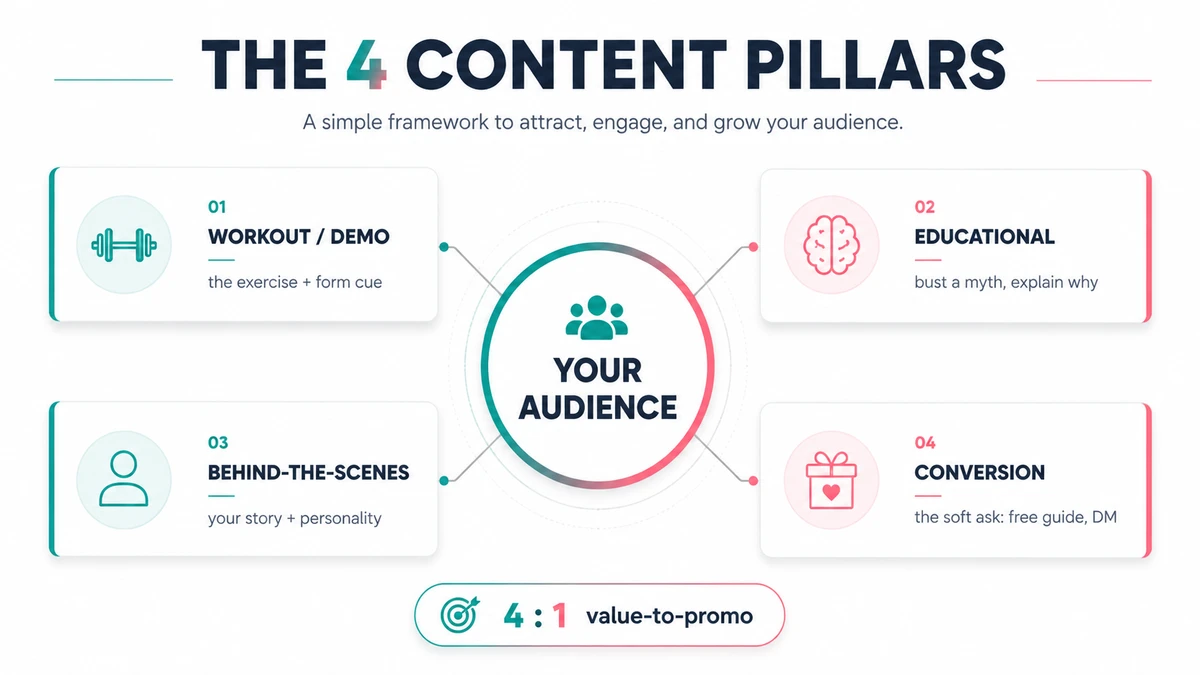
The practical version is a content-pillar mix. Rotate four types so every post has a job:
- Workout / demo — the exercise, the form cue, the follow-along. This is your proof.
- Educational — bust a myth, explain why a movement works, break down a mistake. This builds authority.
- Behind-the-scenes / personality — your own training, your story, your setbacks. This builds the relationship.
- Conversion — the soft ask: a free guide, a "DM me," a challenge invite.
Keep roughly a 4:1 ratio — four value posts for every promotion — so you build trust faster than fatigue.
And don't over-produce. As one 2026 trainer strategy put it, the algorithm rewards consistency over polish: "a trainer who posts four times a week with a phone camera will outgrow one who posts once a month with studio lighting."
Step 4: Pick one platform to win, then borrow the others
Trying to be everywhere at once is how beginners burn out in month two. Start on one platform, learn its rhythm, then repurpose lightly. Each platform plays a different role:
| Platform | Its job for a beginner | Why |
|---|---|---|
| TikTok | Discovery / reach | Highest engagement and the fastest way for a stranger to find you |
| YouTube Shorts | Evergreen reach | Clips resurface for months, and they build a subscriber base |
| Conversion | Where engaged followers become coaching clients via Reels + DMs |
The engagement gap is real: one 2026 benchmark clocks fitness content at ~6–10% per video on TikTok versus ~3–4% on Instagram Reels and ~2–4% on YouTube. If you want the fastest feedback loop while you're learning, that points to TikTok first, mirror your best clips to YouTube Shorts for the long tail, and add Instagram as your conversion hub once you have an offer.
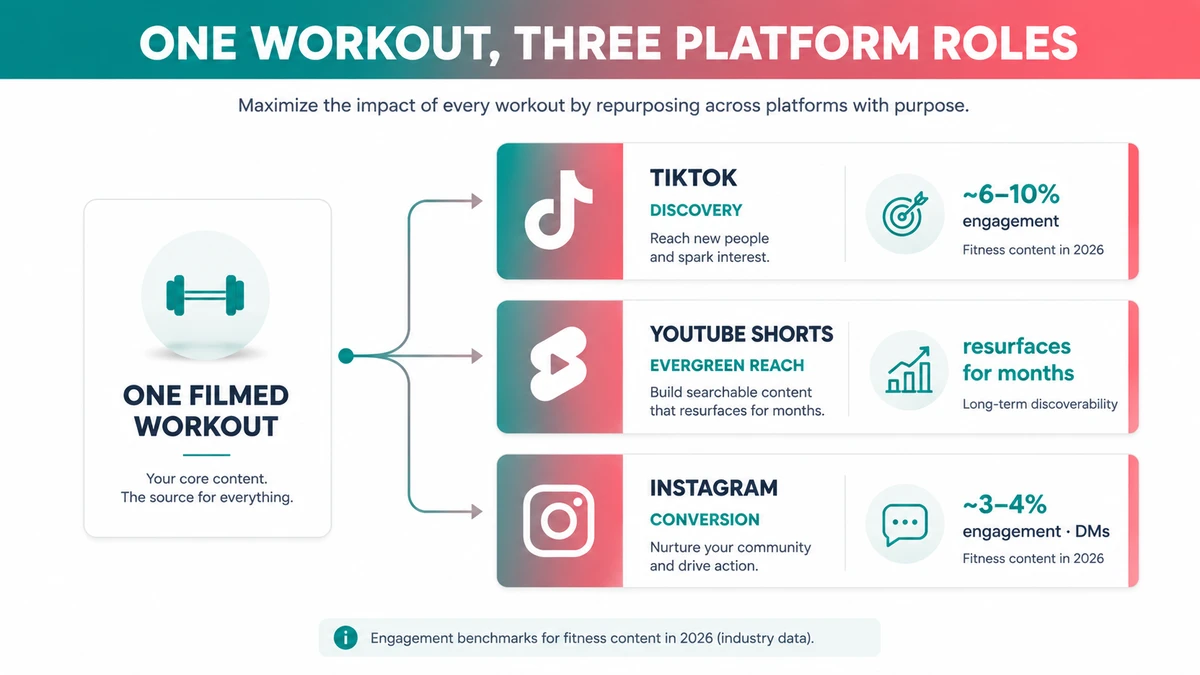
"One platform + light repurposing" beats "everywhere, badly." For the platform-by-platform mechanics once you expand, see per-platform posting best practices and the deeper YouTube growth playbook.
Step 5: Post on a cadence you can actually keep
Consistency beats intensity, and burnout beats both. A realistic beginner cadence is 3–4 posts per week minimum, 5–7 if you can hold it — which pencils out to 60–90 posts in your first 90 days at roughly 60–90 minutes a day.
The trick to hitting that without living in your editing app is to batch: film several clips in one session, then chop them into a week of posts. One 30-minute workout is a goldmine of short clips — the full method is in how to turn workout videos into reels. Pick a schedule you'd keep on your worst week, not your best one. The cadence you can sustain for a year beats the one you abandon in three weeks.
What "growth" actually looks like (the honest timeline)
This is the part the "I hit 100K in 30 days" videos won't tell you. For a new fitness account posting consistently and engaging daily, realistic milestones look like:
- Month 1: ~50–200 followers.
- Month 2: ~200–500.
- Day 90: ~500–1,000 (up to ~2,000 at a higher cadence), at a healthy 3–5% engagement rate.
Reaching 100K? Expect 12–24 months of consistent posting organically. And the sobering one: roughly 83% of fitness creators quit before they ever reach 10K — almost always because they judged month two by a highlight-reel standard. The creators who "make it" are mostly the ones who didn't stop.
So stop counting followers. 1,000 engaged followers outperform 10,000 inactive ones — and, as the next step shows, they can pay your rent long before you're "big."
Step 6: Earn your first dollar before you're "big"
The biggest myth in fitness content is that income arrives at some follower milestone. It doesn't. The money isn't in views — it's in what your content sells. And the sale can come remarkably early: creators are documented earning their first $500–$1,000/month within 90 days — even with under 1,000 followers, by selling coaching and simple products instead of waiting for brand deals.
A realistic beginner stack looks like this:
- 1–2 coaching clients at ~$150/month → $150–$300
- A $27 beginner guide selling ~10 copies/month → ~$270
- Affiliate commissions (a supplement or an app you actually use) → $200–$500
That's roughly $900–$1,200/month from an audience most people would call "too small to monetize." Later, an 8–12-week program (commonly $47–$197) and group coaching stack on top.
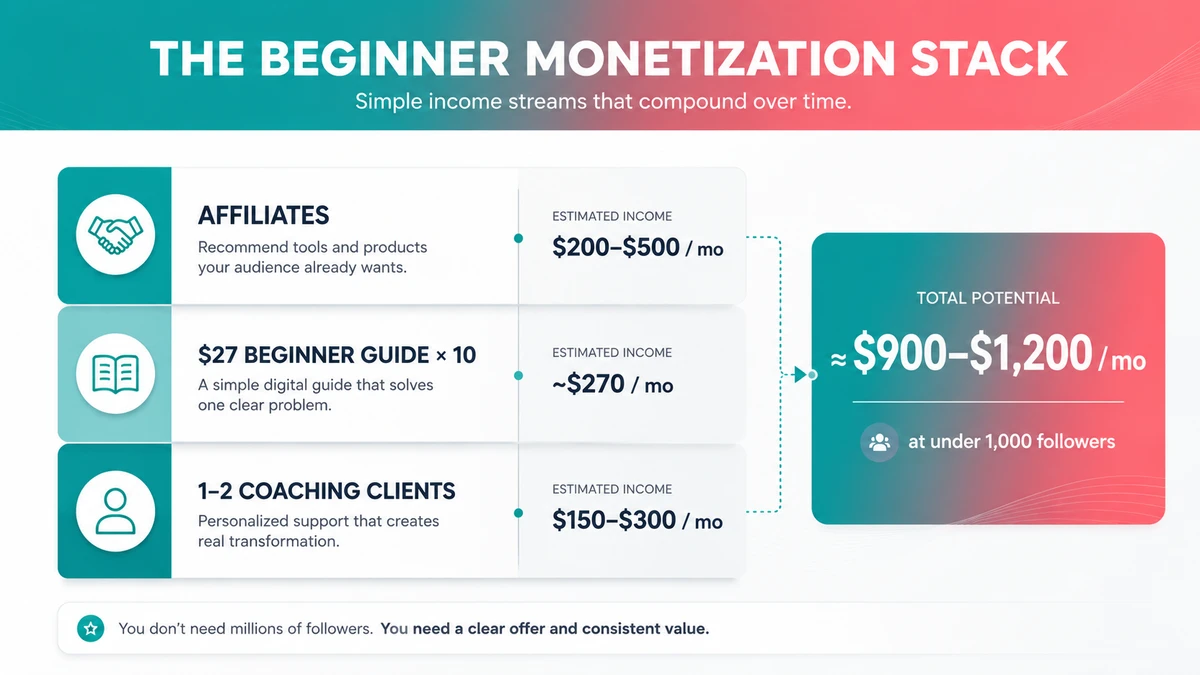
This isn't a fringe strategy — it's where the whole industry moved. Brand deals and ad revenue fell from about 60% of fitness-creator earnings to ~34% in two years, while owned offers took the lead. Put a simple offer in your bio from day one — even "DM me for coaching." For the full picture, read can you really make money creating fitness content? (Results vary — these are gross figures, and income depends far more on your offer and consistency than your follower count.)
The mistakes that stall most beginners
Almost every stalled fitness account is making at least one of these:
- No clear niche — posting for everyone, remembered by no one.
- Only workout demos — no personality, no education, nothing to follow you for.
- Weak hooks — the first 1–2 seconds don't earn the scroll.
- Bad audio — the one fixable thing that quietly kills retention.
- Posting everywhere at once — spread too thin to learn any single platform.
- Post-and-ghost — no replies, no community, no read of the analytics.
- Waiting to monetize — no offer in the bio, so the audience has nothing to buy.
Fix the niche, the audio, and the offer first. Those three move the needle more than any camera.
Start this week
A fitness content career isn't unlocked by gear or a follower count — it's built by the boring compounding of showing up. Pick the narrow niche you already live in. Film the first one on your phone today. Put an offer in your bio before you feel ready.
The real constraint isn't talent — it's volume: sustaining a multi-platform cadence solo is exactly where most creators quit. Batching helps, and AI editing tools (ActiveSnap among them) can turn one filmed session into a week of platform-ready posts, so one person can keep the pace without hiring an editor. But the tools are optional. The starting is not.
Save this roadmap, pick your niche, and post the first one before the week is out.